Tom's Guide Verdict
The 2026 Fitbit Air is a discreet and distraction-free (no screen) fitness tracker that's easy to use, lightweight, and oh-so-comfortable. Just $99 and subscription-free for core features, it offers a week of battery, and covers all the holistic metrics you'd expect from a modern device, like heart health, sleep quality, daily movement, and workouts. Plus, the Air is just as reliable at logging sleep trends and fitness efforts as Garmin watches that cost 2.5x as much; just be sure to carry a paired smartphone for location tracking. All of your data and insights are neatly organized within the new Google Health companion app, formerly the Fitbit app.
Reasons to buy
- +
Distraction-free health and fitness tracking
- +
$99 and subscription-free for primary features
- +
Smaller and lighter than the competition
- +
Remarkably comfortable
- +
Wide selection of attractive straps; swapping straps is a breeze
- +
Lots of valuable wellness insights; top-notch sleep reports
- +
Easy-to-navigate app
- +
Compatible with Android and iOS
- +
One week or more of battery per charge
Reasons to avoid
- -
No onboard GPS or altimeter for location/elevation data without carrying a smartphone
- -
Automatic workout tracking only kicks in after 15 minutes; limited to a small number of exercises
Why you can trust Tom's Guide Our writers and editors spend hours analyzing and reviewing products, services, and apps to help find what's best for you. Find out more about how we test, analyze, and rate.
Good things should be worth the wait. After all, the legendary neo-soul recording artist D’Angelo kept us waiting 14 years for his third and arguably most groundbreaking album, Black Messiah. Google hasn’t made us wait quite as long for a new Fitbit model; the last Fitbit designed for adults debuted in 2023 — the Fitbit Charge 6 — while the latest entry-level addition to the lineup, the Fitbit Inspire 3, launched in 2022.
Thankfully — and much to my surprise — Google’s Fitbit draught ended in early May with the debut of the ultra-petite, screen-free, and subscription-optional Fitbit Air.
Priced at just $99, the Fitbit Air is designed to be a set-it-and-forget-it, ultra-discreet health tracker with 24/7 heart rate monitoring, detailed nightly sleep reports, basic fitness tracking, recovery recommendations, women’s health tracking, and perhaps most notably, zero buttons or smart features.
I tested the Fitbit Air for over a week, and I may never take it off. The Fitbit Air is easily the best no-fuss, bang-for-your-buck, screen-less fitness tracker on the market in 2026. That's right, forget the more advanced, serious-athletes-only, wallet-draining Whoop 5.0, here’s why I’ll be recommending the Fitbit Air to users far and wide for the foreseeable future.
Fitbit Air: Specs compared

| Header Cell - Column 0 | Fitbit AIr |
Whoop 5.0 |
Helio strap |
Polar Loop |
|---|---|---|---|---|
Starting price |
$99 |
Free with subscription |
$99 |
$199 |
Subscription cost |
Optional, $9.99 a month or $99 per year |
$199, $239 or $359 per year depending on tier |
n/a |
n/a |
Dimensions (without strap) |
35 x 17 x 8 mm |
35 x 24 x 11 mm |
34 x 24 x 11 mm |
28 x 43 x 10 mm |
Weight (without strap) |
5.2 g |
26.5 g |
20 g |
20 g |
Sensors |
Heart rate, SpO2, Skin temp, Accelerometer, Gyroscope |
Heart rate, SpO2, Skin temp, Accelerometer, Gyroscope |
Heart rate, SpO2, Skin temp, Accelerometer, Gyroscope |
Heart rate, Skin temp, Accelerometer |
Water resistance |
50 meters |
10 meters |
50 meters |
30 meters |
Battery life |
7 days |
14 days |
10 days |
8 days |
Compatibility |
Android, iOS |
Android, iOS |
Android, iOS |
Android, iOS |
Fitbit Air value: 5/5
- At $99 and subscription-free for core features, the Fitbit Air is one of the best value screenless trackers available in 2026
- An optional Google Health Premium account unlocks personalized AI-backed health and fitness insights, along with deeper dives into your holistic trends; it's $9.99 a month or $99 a year
- Cost-wise, the Fitbit Air is the same price as 2022's entry-level Fitbit Inspire 3 tracker, which is still sold by Google (but often for $79); the Air is less than the GPS-sporting Fitbit Charge 6 ($159)

The Fitbit Air is $99, the same price that the Fitbit Inspire 3 debuted at in 2022. This may have you thinking that the Air replaces the Inspire 3 in the brand's lineup, but that's not the case. Google will continue selling the Fitbit Inspire 3 for $79-$99 and the Fitbit Charge 6 for $159 for the foreseeable future.
The Fitbit Air will set you back $99 paired with one of Google's standard silicone or kniy straps or $129 paired with the special edition Stephan Curry strap (which I'm a big fan of, more on that below).
Compared to the competition, the Fitbit Air is the same price as the Amazfit Helio Strap and half the price of the Polar Loop, both of which are also subscription-free. The Fitbit Air is additionally less than half the price of the cheapest annual Whoop subscription.
Speaking of subscriptions, some of the more advanced features, like AI-backed recommendations and trend insights, require a Google Health Premium (previously Fitbit Premium) subscription for $9.99 a month or $99 for the year; full review of that coming soon.
Ultimately, the Fitbit Air ships with a three-month trial to Premium to help you decide whether those additional features are worth it to you, something I appreciate.
Fitbit Air value: 5/5
Fitbit Air design and comfort: 5/5
- The Fitbit Air is smaller, lighter, and more comfortable than the competition
- Better water resistance than Whoop 5.0
- Designed to be swapped from strap to strap with ease
- The special edition Stephen Curry strap is the comfiest of Google's initial offerings

The Fitbit Air doesn't have a screen or any buttons; however, it does have a haptic motor, which can be set to vibrate for a limited number of use cases, most notably as a way to gently and silently wake you up via Google's Smart Alarm function. You cannot set it to vibrate to alert you to incoming texts, calls, or other smartphone notifications.
The Fitbit Air is noticeably smaller, thinner, and lighter than all of its competitors, including the Whoop 5.0, Polar Loop, and Amazfit Helio Strap.
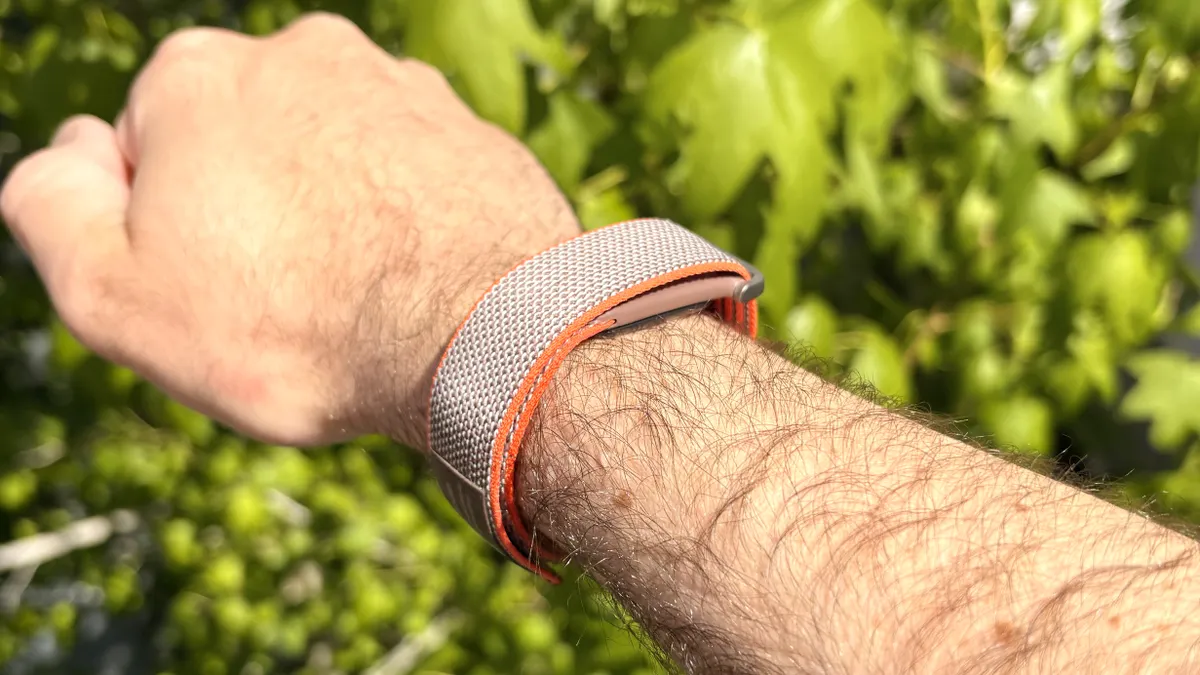
Weighing just over 5 g and with a tiny footprint, the Fitbit Air is not only extremely comfortable, especially on the special edition Stephen Curry strap, but it also doesn't really resemble a fitness tracker... like, at all. Instead, it looks more like a sporty bracelet than a tech gadget.
Water resistance is 50 meters, which beats the pants off the Whoop 5.0, and should be enough to protect the Air during short surface-level swims, showers, hand-washing, etc.

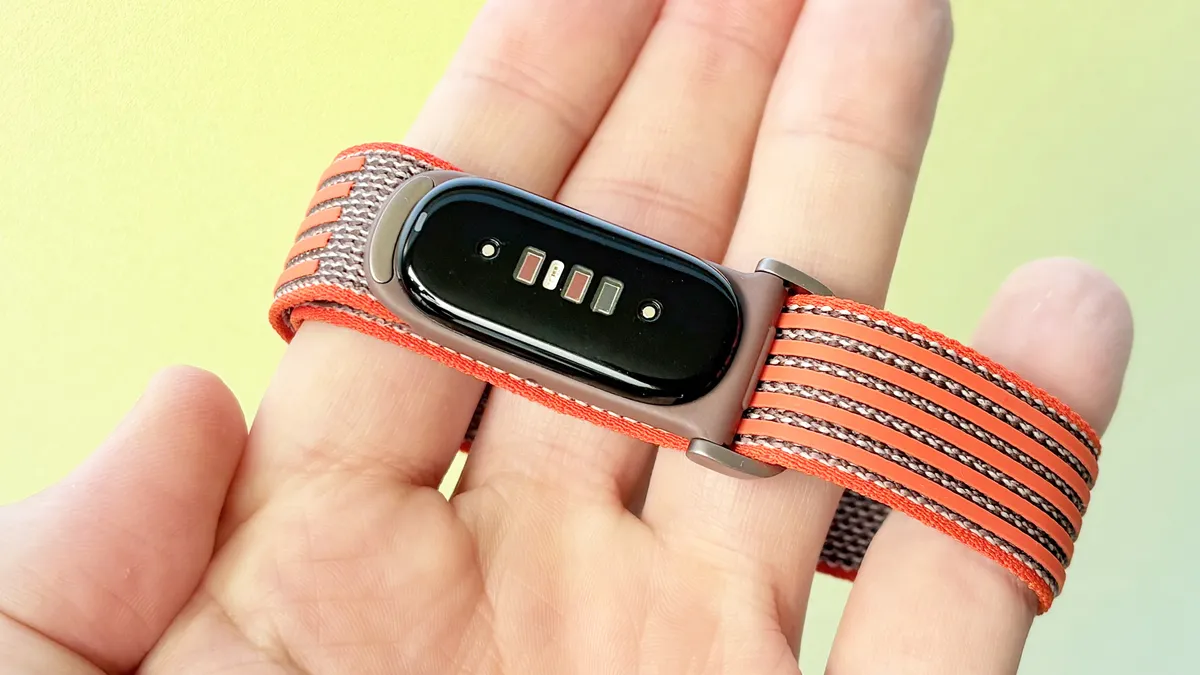
The tracker itself is nothing more than a small plastic pebble with some sensors and charging contacts on the underside. However, because it's protected by the strap, it's nearly impossible to damage the tech components, even if you slam your wrist unintentionally into a wall.
Customization is a big selling point of the Air. The tracker itself, which looks like a slimmed-down Inspire 3 without straps, pops with delightful fashion in and out of its housing with a firm push.
Google is selling a fairly wide selection of straps, starting at $34.99, in all sorts of eye-catching colors. Choose from sporty silicone or stretchy knit fabric. Meanwhile, wallet-friendly, third-party straps have yet to materialize on Amazon and the likes, but give it time.
It's worth calling out the Steph Curry strap, because it feels a lot more premium, breathable, and less scratchy than the standard knit strap Google offers with the device for $99.
Health tracking: 4/5
- Lots of sleep tracking insights on par with the best fitness trackers and best smartwatches
- User-friendly app for tracking holistic trends like resting heart rate, average calorie burn, step count, heart rate variability, menstrual cycles, and daily readiness
- Some health tracking features require a Google Health Premium subscription, like AI-analyzed sleep trend recommendations (via Google Coach)

The Fitbit Air sports an onboard continuous heart rate tracker, blood oxygen saturation (SpO2) reader, and body temperature sensor for keeping tabs on all your core holistic metrics, including heart rate variability trends, breath rate, cardio load, and daily readiness, a numeric score out of 100.
For a $99 wearable, the Fitbit Air provides detailed sleep reports on par with some of the best smartwatch models in 2026, with insights into your sleep duration, time spent in sleep cycles, restlessness, and daily sleep quality rating and score, also out of 100.
For a $99 wearable, the Fitbit Air provides detailed sleep reports on par with some of the best smartwatch models in 2026
| Header Cell - Column 0 | Fitbit Air |
Forerunner 70 |
|---|---|---|
Sleep Score |
73, Fair |
66, Fair |
Sleep duration |
7 hours 37 mins |
8 hours 9 mins |
Average heart rate |
66 bpm |
65 bpm |
REM sleep |
30 mins |
1 hours 35 mins |
Light sleep |
5 hours 59 mins |
5 hours 45 mins |
Deep sleep |
41 mins |
49 mins |
I tested the Fitbit Air against the Garmin Forerunner 70 nightly for a week straight. The chart above shows recent results, logged during the same night from each tracker. While the data doesn't match perfectly, the results are pretty darn close across the board, suggesting that the Fitbit Air is just as capable of logging sleep quality as a device 2.5 times its cost.
Google completely overhauled the Fitbit companion app, now called 'Google Health,' and the results are an easy-to-navigate experience with quick and easy access to whatever metrics you value most — the app is highly customizable — along with just the right amount of context and analysis to prove useful but not overwhelming.
Fitbit Air fitness tracking: 3/5
- Reliable fitness tracking performance when you carry a paired smartphone for location and elevation data
- Auto workout mode only starts tracking after 15 minutes and is limited to a handful of common exercises
- Similar heart rate tracking reliability to entry-level Garmin watches; no apparent performance differences between tracking on left vs right wrists
- Personalized AI-backed adaptive fitness plans require a Google Health Premium subscription

Like nearly every screen-less wearable, the Fitbit Air lacks an onboard GPS for location data and an altimeter for elevation insights. This means that you'll want to carry your paired smartphone when performing outdoor workouts for the Air to piggyback off of, to ensure reliable distance, pace, and elevation gain metrics.
The Fitbit Air automatically tracks a small selection of workout types, including walks, bike rides, 'sports,' and 'other activities.' It does so whether you carry your paired phone or not, but there's a catch. For an activity to be auto-logged, you have to do it for at least 15 consecutive minutes.
I'm a newbie runner who jogs roughly 1.5 miles several times a week. That often takes me less than 15 minutes, which means that I have to manually open the Fitbit app on my phone and start a running workout session to ensure the Air actually logs it. This is less than ideal, IMHO, and Google should instead lower the auto workout threshold for the Air to five minutes instead.
The selectable tracking modes for the Fitbit Air in the app are also somewhat limited compared to the competition, with just 41 to choose from. For example, there isn't even a pickleball mode!

| Header Cell - Column 0 | Fitbit Air |
Forerunner 70 |
Control |
|---|---|---|---|
Steps |
3,004 steps |
2.996 steps |
3,000 steps (manual count) |
Distance |
1.61 miles |
1.57 miles |
1.60 miles |
Climb |
165 feet |
154 feet |
176 feet |
Pace (elapsed) |
18 mins 31 secs per mile |
17 mins 48 secs |
18 mins 21 secs |
Average heart rate |
116 bpm |
125 bpm |
n/a |
Max heart rate |
161 bpm |
163 bpm |
n/a |
The Fitbit Air tracks your heart rate with similar reliability to Garmin's top entry-level smartwatch, regardless of which wrist you wear it on
When carrying a paired smartphone, fitness tracking performance from the Fitbit Air is top-notch. I walked 3,000 steps — manually counted — with the Fitbit Air vs Garmin Forerunner 70 vs Strava running on an iPhone 16, and the Air proved just as accurate across the board as the others (though its pace data was a little sluggish).
To ensure similar heart rate tracking capabilities on either wrist, I performed 50 jumping jacks with the Air on first on my left and then on my right wrist (giving time for my heart to return to a resting rate in between). I also wore the Garmin Forerunner 70 on the opposite wrist of the Air during testing for an additional data set. The results: The Fitbit Air tracks your heart rate with similar reliability to Garmin's top entry-level smartwatch, regardless of which wrist you wear it on.

| Header Cell - Column 0 | Fitbit Air |
Forerunner 70 |
Strava |
|---|---|---|---|
Distance |
1.48 miles |
1.44 miles |
1.52 miles |
Pace per mile |
9 mins 38 secs |
9 mins 11 secs |
8 mins 35 secs |
Elevation gained |
76 feet |
85 feet |
78 feet |
Average heart rate |
156 bpm |
158 bpm |
n/a |
Max heart rate |
176 bpm |
177 bpm |
n/a |
Calories burned |
168 calories |
158 calories |
n/a |
In addition to testing the Fitbit Air while walking and doing aerobic workouts, I also tested it against Garmin and Strava while going for a 1.5-mile run. In this test, the Air's results once again line up nicely with the competition.
Of course, for the most valuable insights into your fitness trends, you'll want to take Google Health Premium for a spin, which notably unlocks Google's Gemini-backed 'Coach,' a personalized, holistic concierge that is far more helpful, in my testing, than Apple's 'Workout Buddy' or Samsung's 'Running Coach.'
For example, after a week of less-than-ideal sleep and more workouts logged than normal, the Coach not only advised I take it easy, but also gave me targets for how much sleep to get in the next few nights, low-key workout suggestions that target muscle groups I didn't utilize in recent days, and big picture advice based on my fitness goals and recent performance.
Fitbit Air battery life: 4/5
- The Fitbit Air lasted over a week in my testing, meeting its advertised rating
- It also recharges quickly: 0 to 100% in roughly 90 minutes
- Whoop 5.0 boasts double the battery life of the Fitbit Air

The Fitbit Air is rated to last up to seven days per charge. After exactly one week of testing the Fitbit Air on my wrist, I still had 15% battery remaining. During my time wearing the device, I recorded around a dozen workouts and only took the tracker off while showering.
Google says you can fully recharge the Air from 0% to 100% battery in roughly 90 minutes, a claim that also proved true in my testing.
Sure, the Whoop 5.0 offers double the advertised battery life of the Fitbit Air, but it also weighs roughly five times more. Besides, a week of battery is more than enough in my opinion, especially when you consider that some of the best smartwatch models only last for one day per charge... cough, cough, Apple Watch 11.
Fitbit Air review: Verdict
The combination of a completely distraction-free user experience, an affordable price, reliable holistic features, excellent comfort, impressive battery life, and no subscription requirement all add up to the Fitbit Air being my new favorite fitness tracker in 2026
I tested the Fitbit Air for a week, and I have no intentions of taking it off anytime soon. In fact, it's hands down my favorite screenless, subscription-free tracker on the market today and a great choice for anyone looking to learn more about their health trends without breaking the bank or straining their wrist. In short: It's a Whoop 5.0 for the rest of us.
Smaller, lighter, and overall more comfortable than alternatives from Whoop, Amazfit, and Polar, it may not have the best-in-class battery life, but at over a week per charge, it's good enough for me. While you'll find more in-depth fitness tracking insights from the best GPS sport watches, the Fitbit Air covers all the basics well, even if the auto-workout tracking could use refinement and an expansion of exercise types.
Ultimately, the combination of a completely distraction-free user experience, an affordable price, reliable holistic features, excellent comfort, impressive battery life, and no subscription requirement all add up to the Fitbit Air being my new favorite fitness tracker in 2026, and a wearable I'll be recommending to all sorts of wellness and fitness enthusiasts.
Fitbit Air final score: 21 out of 25