Club Benefits





If you're shopping for a TV this year, there's a good chance you'll find yourself choosing between two all-new types: RGB LED and Super Quantum Dot (SQD) Mini-LED.
Several brands make and sell RGB LED TVs, while only one brand — TCL — engineers SQD sets. Somewhat confusingly, RGB LED TVs are known by many names (like Micro RGB), as each brand adds its own spin to the technology.
Although both technologies aim to amplify color, they each come with their own strengths and weaknesses. If you're hoping to buy the best TV for your viewing habits and home setup, I can help.
RGB LED: strengths and weaknesses
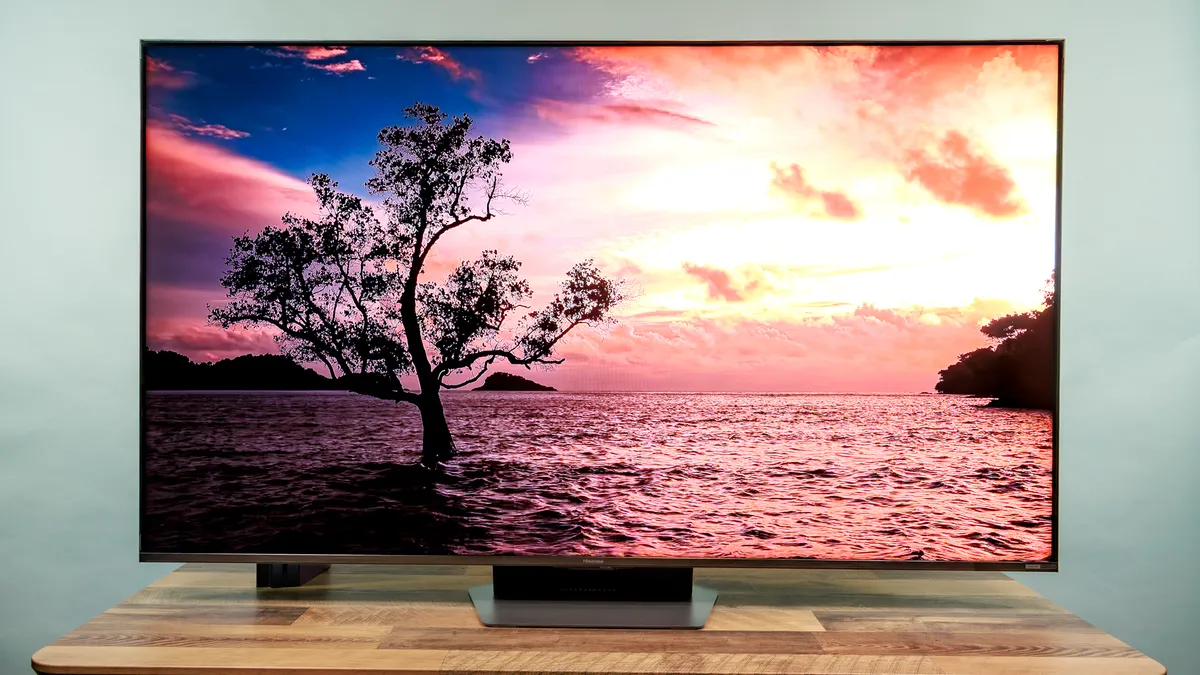
Each brand's take on RGB LED technology has its own name. There are Hisense RGB Mini-LED TVs, Samsung Micro RGB TVs, LG Micro RGB evo TVs and Sony True RGB TVs. TCL calls its version RGB Mini-LED, as well.
These TV makers offer their own approach to the hardware- and software-based components of RGB LED technology, but broadly speaking, every version operates in a similar fashion.
While garden-variety Mini-LED TVs leverage white- or blue-colored LEDs in conjunction with color filters, RGB LED TVs make use of teeny-tiny red-, green- and blue-colored LEDs. Like standard Mini-LED backlights, RGB LEDs are clustered into dimmable zones, too, but their added color typically results in better, brighter color.
We've seen this advantage borne out in the testing we've carried out on RGB LED TVs. They're bright, punchy sets that offer some of the most voluminous color we've measured to date, surpassing even some quantum dot-equipped OLED TVs. The Hisense UR9, for instance, covers an impressive 93% of the BT.2020 color gamut — one of the best readings we've ever measured for TV color.

RGB LED TVs often exhibit something called color crosstalk.
The primary weakness of RGB LED TVs is the primary weakness of every LED-based TV: They aren't capable of the perfect black levels and pixel-level dimming you'll see on the best OLED TVs.
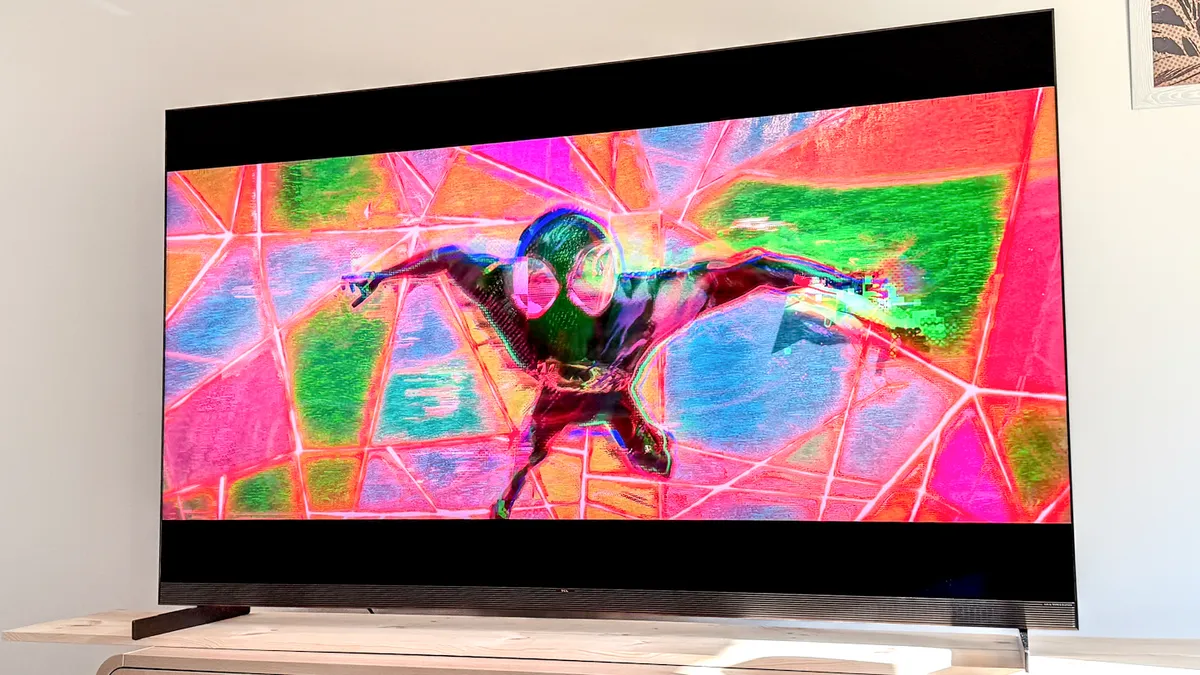
Compared to standard, quantum dot-equipped Mini-LED TVs and Super Quantum Dot-based models, the drawbacks of RGB LED are less obvious. Their colored LEDs are terrific at driving a ton of luminance to big, bold swaths of easy-to-produce hues (as seen in the image above), but depending on the make and model, an RGB LED TV might fall back to white light and color filtering when average content is on the screen.
In addition, RGB LED TVs often exhibit something called color crosstalk. This happens when white-tinted or light-colored objects shift in hue as competing colors appear around them. The frequency with which this visual hiccup occurs is entirely dependent upon the intricacies of a given RGB LED TV's hardware and the software functions that oversee it.
That brings me to my final point: Perhaps more so than any other LED-based TV technology, RGB LED TVs are very much at the mercy of the TV's processing capabilities. As time goes on, I suspect that we'll see clear delineations between brands' abilities to engineer RGB LEDs and, most importantly, sidestep the technical issues associated with the nascent technology.
Super Quantum Dot: strengths and weaknesses
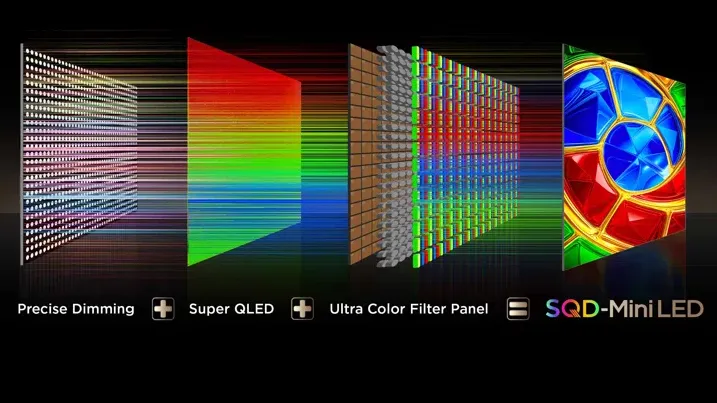
Like RGB LED TVs, Super Quantum Dot sets aim to bolster color brightness by way of LED backlighting. However, rather than reinvent the wheel entirely, SQD technology is more akin to a remix of traditional quantum dot-enhanced Mini-LED performance.
The Super Quantum Dot recipe consists of several ingredients: reformulated quantum dots, a new, advanced color filter to harness those quantum dots and some onboard, software-based algorithms designed to keep color performance consistent. (TCL refers to that bit as its Advanced Color Purity Algorithm.)
According to our testing, SQD succeeds in delivering brighter, purer color than what you'll usually see on a traditional quantum dot-enhanced Mini-LED TV. For instance, the sensational TCL QM8L covers an impressive 90% of the BT.2020 color space. That's not quite as high as what we've measured on Hisense's top-performing RGB LED TV, but it's better than some top-shelf QD-OLED TVs.
Once again, it's worth noting that SQD isn't capable of the eye-popping, high-contrast look of OLED. For our purposes, though, let's set that aside once more and compare it to RGB LED.
We've yet to test all of the year's RGB LED TVs, but many of them are clocking in just below the Hisense UR9's impressive 93% benchmark for BT.2020 color volume, right around 91% to 92%. So, while they might have a bit of an edge on paper, SQD is not far behind at all.
As I see it, the biggest obstacle standing between SQD and shoppers is the variety of choice — or lack thereof.
Super Quantum Dot is a TCL-exclusive technology, so right now, there are only three models available: the TCL X11L, the QM7L and the aforementioned QM8L. RGB LED, meanwhile, has taken hold of every major brand's lineup this year.
RGB LED vs SQD: Outlook
Ultimately, the story of both of these new technologies won't fully take shape until next year, when the brands behind them have had enough time to iron out performance wrinkles and possibly extend this hardware into additional price tiers.
Affordable options could be the key to successful expansion. Unfortunately, for prospective SQD buyers looking to save some cash, there's only a couple of picks: the TCL QM7L and QM8L.
Similarly, there are only a handful of RGB LED TVs available right now that aren't high-end options. We're still working our way through these step-down options (like the Samsung R85H, the Hisense UR8 and the Sony Bravia 7 II), but as the year goes on, these models might prove to be the most popular in the RGB LED class.
The good news? Both of these technologies, so far, are proving to be excellent options for your living room.

Follow Tom's Guide on Google News and add us as a preferred source to get our up-to-date news, analysis, and reviews in your feeds. Alternatively, you can read our content on the Tom's Guide app available now for iOS and Android. Subscribe to Tom's Guide on YouTube and follow us on TikTok. Finally, you can visit our dedicated Tom's Guide Savings Squad hub for expert help on getting the best products for less.
More from Tom's Guide