




Apple has just announced the MacBook Pro with PROLED XDR Display, and not only have we already gone hands-on with it (spoiler alert: it's jaw-dropping), we've already tested the chip inside.
You see, it packs the M5 Pro and the M5 Max — two chips we've already benchmarked extensively in the mini-LED MacBook Pros. This is good news for buyers: You don't have to go in without knowing what you're getting.
Of course, there are some differences that may change results here. For example, this is a significantly lighter laptop with an OLED display — two variables (battery capacity and screen) that may change a couple things here. But we already get a good insight from these numbers.
Here's what kind of performance we expect to see from the new MacBook Pro and how we expect it to stack up when faced with some of the best laptops.
What's inside the OLED MacBook Pro?
| Header Cell - Column 0 | 2026 MacBook Pro with PROLED XDR Display |
2026 Mini-LED MacBook Pro |
|---|---|---|
Price |
14-inch from $2,899, 16-inch from $3,399 (M5 Pro); M5 Max from $4,499 (14-inch) and $4,799 (16-inch) |
14-inch from $2,499, 16-inch from $2,999 (M5 Pro); M5 Max from $4,099 (14-inch) |
Display |
14.2-inch or 16.3-inch PROLED XDR (tandem OLED), 120Hz |
14.2-inch (3024 x 1964) or 16.2-inch (3456 x 2234) mini-LED, 120Hz |
Brightness |
Up to 2,000 nits peak SDR and HDR (rated) |
540 nits SDR, 1,026 nits HDR (tested, 16-inch) |
Touchscreen |
Yes, with the touch sensor built into the display and a redesigned hinge |
No |
Camera cutout |
Dynamic Island |
Notch |
Chip |
M5 Pro or M5 Max |
M5 Pro (15- or 18-core CPU, 16- or 20-core GPU) or M5 Max (18-core CPU, 32- or 40-core GPU) |
Memory |
Up to 128GB |
Up to 64GB (M5 Pro), up to 128GB (M5 Max) |
Storage |
Up to 16TB |
From 1TB (M5 Pro), from 2TB (M5 Max); up to 8TB |
Ports |
3x Thunderbolt 5, HDMI, SD card slot, headphone jack, MagSafe |
3x Thunderbolt 5, HDMI, SD card slot, headphone jack, MagSafe |
Wireless |
Wi-Fi 7, Bluetooth 6 |
Wi-Fi 7, Bluetooth 6 |
Battery life |
Up to 24 hours (16-inch M5 Pro, rated) |
Up to 24 hours rated (16-inch M5 Pro); 21:25 tested |
Weight |
From 3 pounds (14-inch), from 4 pounds (16-inch) |
3.56 pounds (14-inch M5 Max), 4.7 pounds (16-inch M5 Pro) |
Release date |
Pre-orders October 28, on sale November 6 |
March 11, 2026 |
As expected, Apple decided to skip the M6 Pro and M6 Max for this round of MacBooks. Instead, the focus is solely on other upgrades, while the chips remain the same. We did, however, get the MacBook Pro M6 a day before Apple's event, but that one doesn't have the PROLED screen that these new models do.
According to Mark Gurman, Apple isn't developing the M6 Pro and the M6 Max, and while the base M6 is faster in single-core tasks, it can't match the M5 Pro and the M5 Max in multi-core or graphics performance.
Apple M5 Pro and M5 Max: Performance
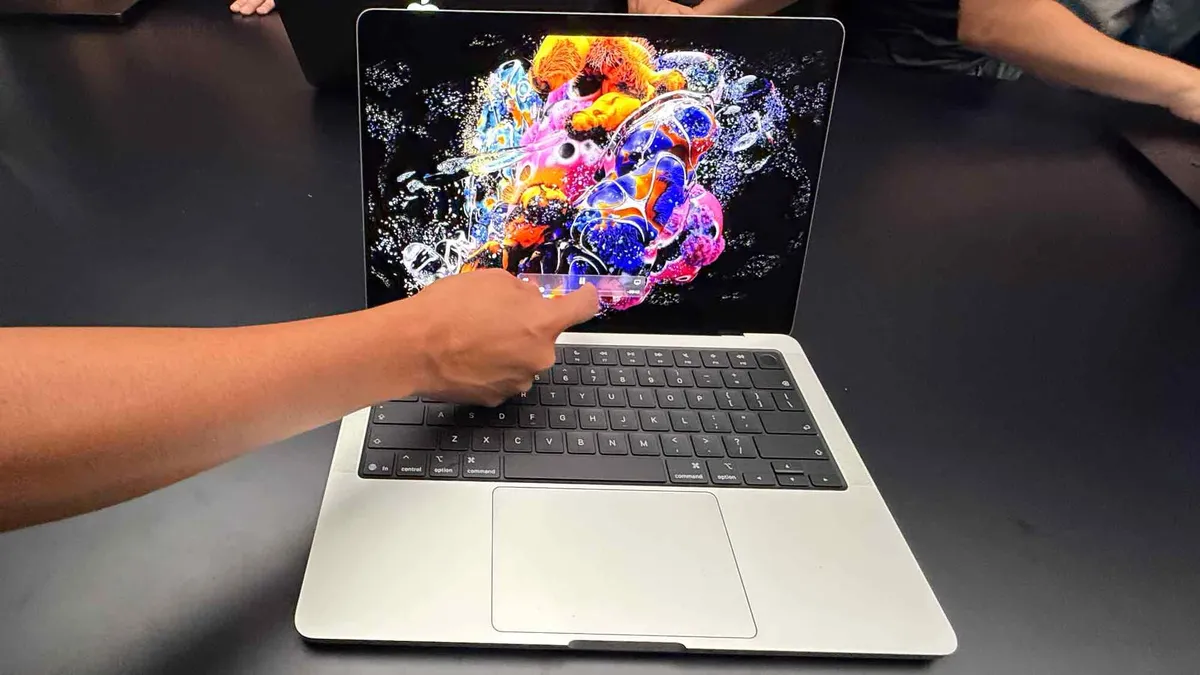
The M5 Pro and the M5 Max have been around since March 2026, which has given us plenty of time to test them thoroughly. While there might be some subtle differences in performance that are unrelated to the two processors, we expect raw numbers to be similar to what we've already seen in our MacBook Pro M5 benchmarks.
Apple did say that the new MacBook Pros have a completely redesigned thermal system, so that could let the M5 Pro and the M5 Max stretch their legs and still maintain that same performance even in a significantly lighter chassis.
To see how they stack up, we pulled our Geekbench 6 results. These benchmarks measure single-core and multi-core performance. There's also our Handbrake test, which times how long a laptop takes to transcode a 4K video to 1080p.
Let's have a look at the base M5 (which you won't find in the new OLED MacBook Pros, but it's a good starting point to compare to), the M5 Pro, the M5 Max, and even the M4 Pro and the M6 to give a well-rounded overview.
Laptop |
Geekbench 6 single-core |
Geekbench 6 multi-core |
Handbrake (min:sec) |
|---|---|---|---|
MacBook Pro 16-inch (M5 Pro) |
4,306 |
28,586 |
1:45 |
MacBook Pro (M5 Max) |
4,338 |
29,430 |
N/A |
MacBook Pro 14-inch (M5) |
4,288 |
17,926 |
3:31 |
MacBook Pro 16-inch (M4 Pro) |
3,910 |
22,822 |
2:38 |
Mac mini (M6) |
4,708 |
21,405 |
2:45 |
Asus Zenbook A16 (Snapdragon X2 Elite Extreme) |
4,070 |
23,407 |
2:07 |
Asus ProArt GoPro Edition (Ryzen AI Max+ 395) |
2,932 |
18,407 |
2:38 |
Asus Zenbook Duo (Core Ultra X9 388H) |
3,031 |
17,283 |
4:22 |
The first thing that jumps out: Single-core scores are nearly identical across the entire M5 family, so this is what we can expect from the new OLED MacBook Pros, too. It's unlikely to feel snappier in such tasks than a base M5 model.
The real gap lies in multi-core, and it's huge. Just look at the numbers: The M5 Pro and M5 Max both land close to 30,000, which is about 25% ahead of the M4 Pro, roughly in line with the up to 30% Apple promised when it launched these chips back in March.
As a reminder, both the M5 Pro and the M5 Max feature the same 18-core CPU. The extra money buys you extra GPU cores and more memory.
The M6 in the Mac mini and the new 14-inch MacBook Pro tops the single-core benchmarks, but it trails both the M5 Pro/Max chips by a wide margin in multi-core.
To summarize: The MacBook Pros released in March were absolute powerhouses. We expect the same of the OLED models.
Apple M5 Pro and M5 Max: Graphics and AI

CPU comparisons are pretty tight between the two chips, but in graphics, we'll find a definite leader. The M5 Max sports up to twice as many GPU cores, and yes, that does lead to huge performance gains.
Laptop |
3DMark Solar Bay (fps) |
3DMark Wild Life Extreme (fps) |
Geekbench AI |
|---|---|---|---|
MacBook Pro 16-inch (M5 Pro) |
178 |
142 |
57,420 |
MacBook Pro (M5 Max) |
268 |
231 |
N/A |
MacBook Pro 14-inch (M5) |
90.4 |
73 |
57,242 |
Snapdragon X2 Elite Extreme |
88.05 |
69.04 |
88,615 |
Asus ProArt GoPro Edition (Ryzen AI Max+ 395) |
163 |
113 |
17,854 |
Asus Zenbook Duo (Core Ultra X9 388H) |
101 |
67 |
56,829 |
We also ran a different set of tests to check out Nvidia's RTX Spark, so this is how the M5 Pro stacks up here:
Laptop |
3DMark Steel Nomad |
3DMark Solar Bay Extreme |
|---|---|---|
Microsoft Surface Laptop Ultra (Nvidia RTX Spark) |
2,912 |
10,594 |
MacBook Pro 16-inch (M5 Pro) |
2,335 |
9,108 |
MacBook Pro 14-inch (M5 Max) |
3,865 |
13,945 |
Asus ProArt GoPro Edition (Ryzen AI Max+ 395) |
1,895 |
6,047 |
Asus Zenbook Duo (Core Ultra X9 388H) |
1,483 |
4,015 |
Both chips beat every Windows laptop in our first table on graphics, which bodes well for the new OLED MacBook Pros. However, Nvidia's new RTX Spark is a different story.
In our more recent testing, it outscored the M5 Pro in both 3DMark Steel Nomad and Solar Bay Extreme. Given the scores and the massively ramped-up GPU performance on the M5 Max, chances are that Apple would win in such a match-up, too.
AI is more nuanced. The M5 Pro scored almost exactly the same as the base M5 in Geekbench AI, and Qualcomm's Snapdragon X2 Elite Extreme leads the pack.
Apple M5 Pro and M5 Max: Battery life

MacBooks are known for their outstanding battery life, so it won't surprise you to hear that in our testing, the LCD models from earlier this year did a great job.
Our 16-inch M5 Pro lasted 21 hours and 25 minutes in our web-surfing test at 150 nits of brightness. That's more than double what Nvidia's RTX Spark and Qualcomm's Snapdragon X2 Elite managed.
The powerful, yet more demanding M5 Max lasted just under 18 hours.
While we can predict the performance of the OLED MacBook Pros with a certain degree of accuracy, the battery life is harder to call. Apple rates the new models at up to 24 hours, which is the same as the mini-LED 16-inch MacBook Pro, and that's despite the lighter chassis. OLED panels use less power on dark content but more on bright, white screens, so we'll need to test it ourselves to see how that 24-hour claim holds up in real life.
Apple OLED MacBook Pro: Outlook

With performance numbers such as these, we fully expect the new PROLED XDR MacBook Pros to be next-level in the best way possible.
As they're equipped with chips we're already familiar with, raw performance numbers should stay roughly the same as before.
With that said, the new OLED models are also pricier. The maxed-out 16-inch model actually goes up to $14,549, but all the new models cost $400 more across the board for the screen upgrade alone.
But you're not paying for more firepower—you're paying for the tandem OLED panel and a couple more goodies, such as a touchscreen and the lack of a display notch. If you're only interested in how capable your laptop is, stick to the LCD versions, as you're getting the exact same chips.

Follow Tom's Guide on Google News and add us as a preferred source to get our up-to-date news, analysis, and reviews in your feeds.
