

I don't know about you, but I am constantly hitting my token usage limits at the worst times. And it seems like whichever model I use, I get stuck much sooner than anticipated. Although AI coding assistants promise to take the hard work out of programming, it seems like the catch is that paying $20 a month doesn't mean you can keep coding for as long as you want. Unlike ChatGPT's unlimited free chatting, coding limitations are actually pretty strict.
Because I was so tired of hitting the wall, I decided to compare which subscription offers better value, particularly for someone who codes regularly but doesn't want to pay $200 a month.
Rather than burn through two subscriptions with unexpected coding challenges, I compared the companies' published usage policies, pricing and available independent research.
What I found is that neither company guarantees a fixed number of coding tasks for $20, and a major change coming to ChatGPT could make that decision even more important. Here's a closer look.
Codex vs. Claude Code: What $20 actually buys
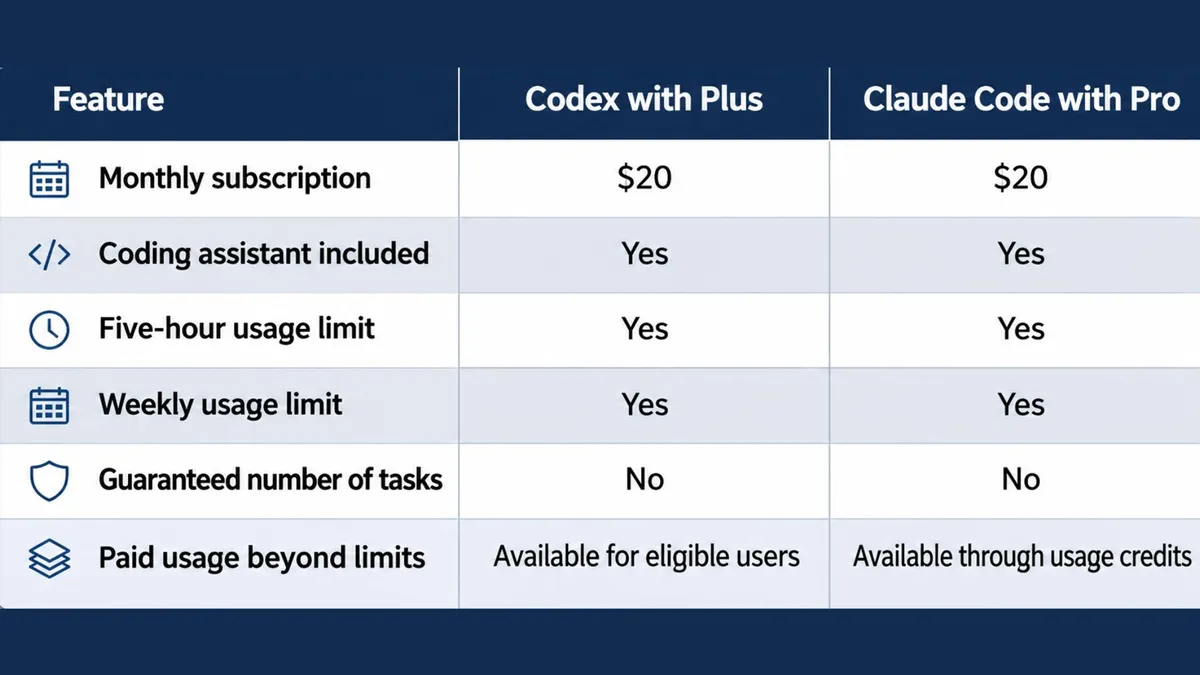
On paper, the subscriptions look very similar. ChatGPT Plus costs $20 per month and includes Codex alongside the regular ChatGPT experience. Claude Pro also costs $20 per month and provides access to Claude Code alongside Claude's chatbot.
Both subscriptions impose 5-hour usage limits and weekly allowances. The key difference is how those allowances work and how clearly users can estimate their remaining usage.
OpenAI publishes estimated message ranges for Codex models, while Anthropic explains that Claude's limits depend on factors including conversation length, model selection and task complexity. In other words, Anthropic remains completely vague about how and when you'll hit your limit.
Neither 5-hour limit means that much time of uninterrupted coding. You can use up your allowance before the window ends, which I have done nearly every day since subscribing.
Codex gives you more information about potential usage
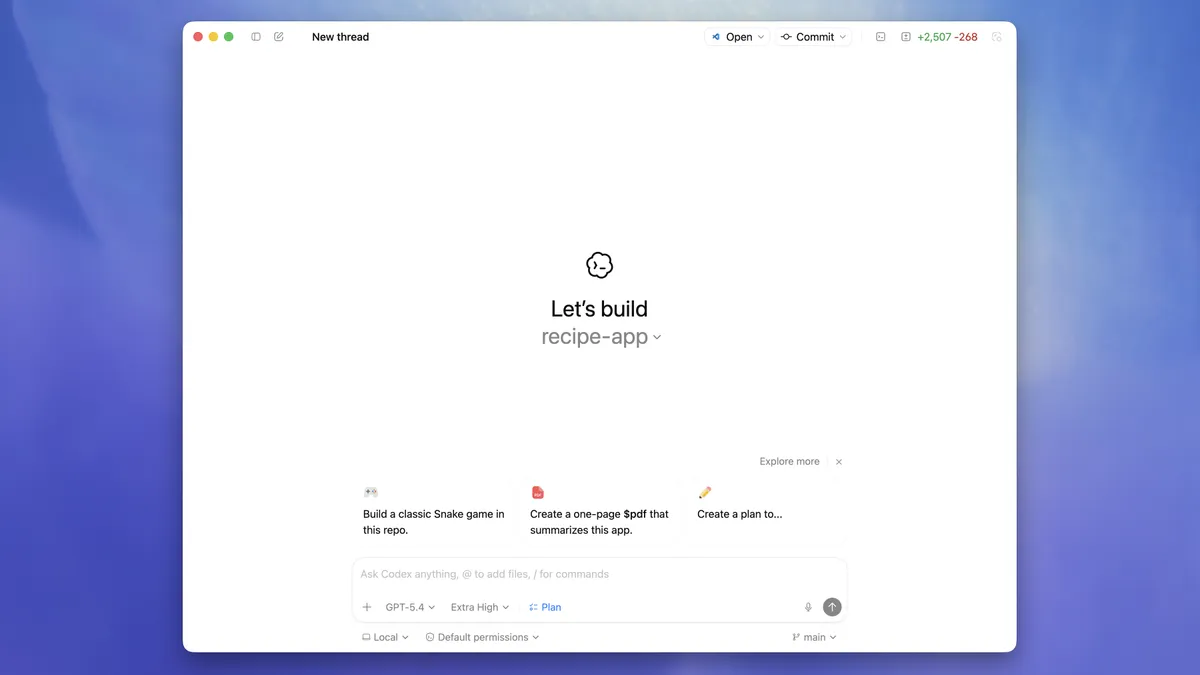
One advantage Codex has is that OpenAI publishes estimated usage ranges for different models. I have found the company's current usage documentation helpful. Knowing what to expect is at least a starting point. From this, I have surmised that ChatGPT Plus users can expect approximately 5 to 45 local messages using GPT-6 Astra within a 5-hour window. Knowing this has helped me manage my token budget much better.
For example, switching to GPT-6.1 Sol increases that estimated range to 15 to 160 messages, while GPT-6 Luna has an estimated range of 350 to 3,000 messages. Clearly, this is an enormous difference depending on which model you choose.
There are caveats, of course. These aren't guaranteed message counts, and a complex task involving multiple steps can consume considerably more usage than a simple request. Cloud tasks may also use more allowance than local messages.
Still, publishing these ranges gives users a better starting point when deciding which model to use.
Claude Code operates under a similar system, but Anthropic doesn't provide an equivalent universal table of guaranteed coding tasks for its $20 Pro subscription.
Instead, it explains that usage depends on the model, conversation length, features and complexity of the work. That makes it difficult — nearly impossible — to predict exactly how far $20 will take you with either platform.
Token usage can vary dramatically

There's another factor worth considering: how many tokens the assistants consume while completing tasks. A Zapier comparison cites a February 2026 benchmark involving a Figma-to-code task.
What matters is how much useful work gets completed before the subscription limit is reached. I find myself hitting a limit much sooner with Claude Code.
According to the comparison, Claude Code consumed approximately 6.2 million tokens while Codex used 1.5 million, a difference of more than four times.
However, Claude Code reportedly produced a more thorough result. That matters because lower token consumption doesn't automatically mean better value if the output requires more work afterward.
More recent data also reinforces how differently developers use these tools. An analysis from whoburnedmore published recently examined reported usage across an opt-in group of 229 developers over 30 days.
Claude Code accounted for 57% of observed tokens, compared with 35% for Codex CLI.
But it's good to note that this wasn't a controlled test of identical coding tasks, and the sample wasn't representative of all developers. It shows how much the participating developers used each tool, not which assistant is more efficient.
The takeaway is that token counts alone aren't enough to declare a winner. What matters is how much useful work gets completed before the subscription limit is reached. In my experience, I find myself hitting a limit much sooner with Claude Code.
Your coding assistant shares its limits with other tools

Here's something anyone considering either subscription should understand. With Claude Pro, usage is shared across Claude's chatbot and Claude Code. This means, if you've been spending the morning researching, analyzing documents or working through a long conversation in Claude, that activity can reduce the allowance available for coding.
Anthropic confirms that usage across its supported Claude interfaces contributes to the same limits.
Codex has a similar consideration, although the structure is changing. Currently, Codex and ChatGPT Work share an allowance, with five-hour and weekly limits applying to Plus users.
But OpenAI says that starting in December 2026, Plus, Pro and Business subscriptions will move toward a shared ChatGPT and Codex usage allowance.
The company says usage will be measured in tokens, with consumption depending on the model and task. Instant chat won't draw from that allowance.
What happens when you hit the limit?

Neither subscription necessarily leaves you without options when you run out of included usage. It's all too tempting to pay for additional usage credits, which switch eligible requests to pay-as-you-go pricing after the subscription allowance is exhausted. But hopefully by understanding what you get, you won't have to now.
Like Claude Code, OpenAI also offers eligible Plus subscribers the option to purchase additional usage or reset their allowance.
The important point is that paying $20 doesn't guarantee unlimited coding with either tool.
If you routinely work on complex applications, large repositories or lengthy agent-driven tasks, you should expect to encounter limits sooner than someone who only occasionally asks for a bug fix.
My verdict: Which $20 subscription is worth it?
After comparing the published policies and my own usage, I'd give Codex the edge for users who want more visibility into their usage, particularly because OpenAI provides estimated message ranges for its different models.
Claude Code remains a compelling choice, especially for users who prefer its workflow or consistently get better results from Claude's models. Personally, I find it the more effective option the majority of the time for my projects.
But if your biggest concern is paying for an assistant that suddenly tells you to come back later, both products require some planning.
For occasional coding, either $20 subscription could be enough. For more intensive work, the models you select, the complexity of your projects and your other AI activity can have a major impact on how quickly those limits disappear.

Follow Tom's Guide on Google News and add us as a preferred source to get our up-to-date news, analysis, and reviews in your feeds.
More from Tom's Guide
- 'We saw it as a threat to our rural way of life' — how 6,600 residents in Upper Sandusky, Ohio, blocked Smartland Energy's $900 million AI data center
- 1 in 4 data centers sits in a water-stressed area — here’s what that means for nearby communities
- AI is changing cancer treatment — and a new breakthrough shows just how far we've come